

SHOW ME THE MONEY – Conference 2025
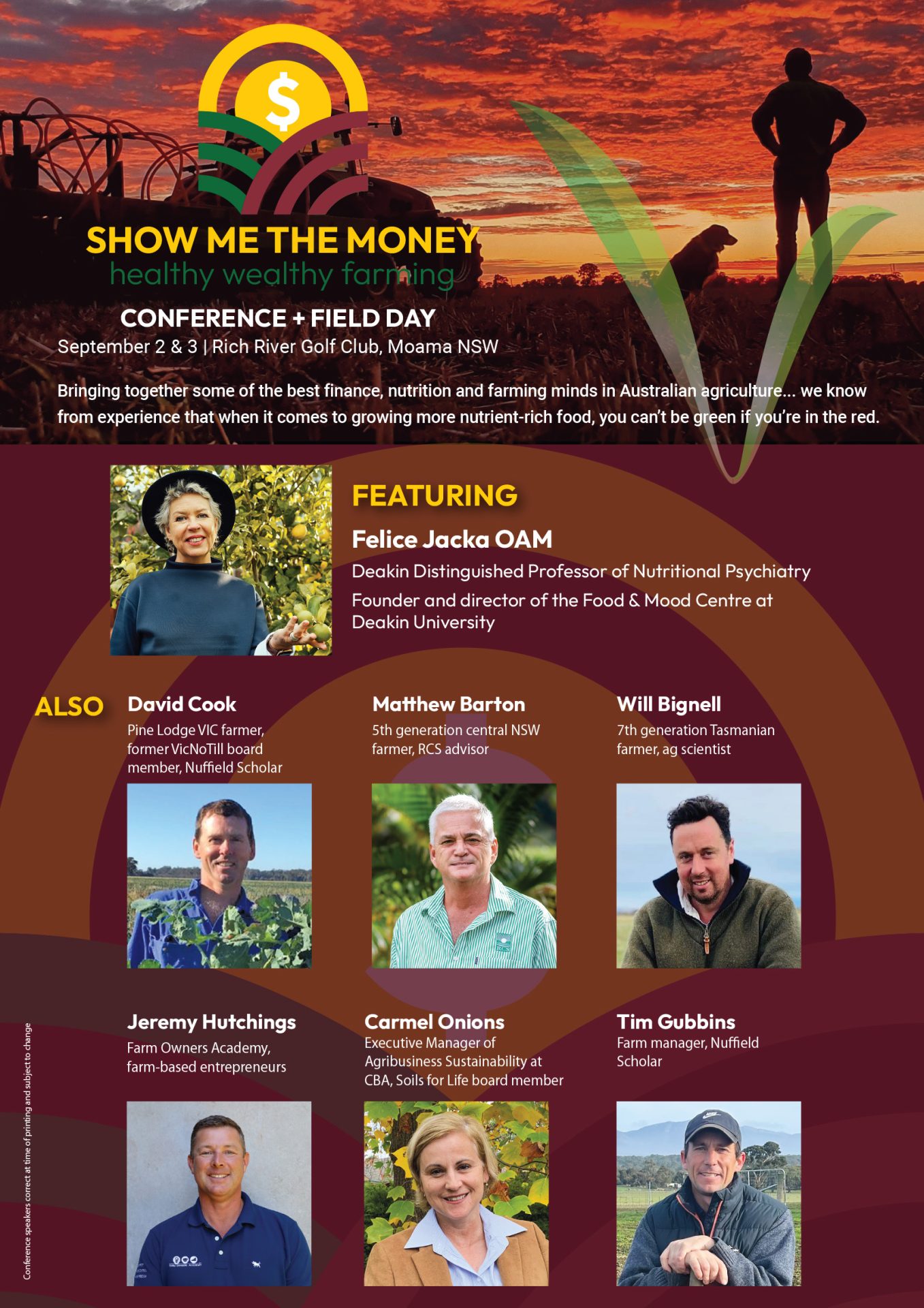
Show Me the Money, healthy wealthy farming
FARM TOUR + CONFERENCE
September 2 & 3
Rich River Golf Club, Moama NSW
FEATURING…
Felice Jacka OAM
– Deakin Distinguished Professor of Nutritional Psychiatry
– Founder and Director of the Food & Mood Centre at Deakin University
– Author of Brain Changer, and There’s a Zoo in my Poo
One of the world’s leading experts on the relationship between what we eat and how it affects our mental health says farmers already growing more nutrient-dense food will be ahead of the game when technology allows consumers to identify the nutritional value of food when they shop.
Felice Jacka, OAM, studies the links between diet and mental health across the lifespan and across the globe. She focuses on both aspects of poor diet quality:
Too little of the ‘good stuff’ such as vegetables, fruits, wholegrains, legumes, healthy proteins and fats.
Too many unhealthy and ultra-processed foods and their influence on mental and brain health.
Results of studies she has led have been highly influential; cited in more than 100 policy documents globally and influencing clinical guidelines in psychiatry in Australia and elsewhere.
Felice has soils, farming systems, and food production in her sights and is one of two Australian researchers sitting on the World Economic Forum’s New Frontiers of Nutrition Initiative steering committee.
“Everyone on this committee agrees we need some way of measuring nutrient density in foods.”
Felice says farmers who are in on growing more nutritious food now are already well ahead of the game.
“I can’t wait to be at the VicNoTill conference and meet these farmers who are at the forefront of improving soil health to improve human health.”
Felice will also highlight the latest research on ultra-processed foods at the conference. In the US and the UK, 60% of energy intake on average is via ultra-processed foods, and this number is getting close to 50% in Australia.
“We believe ultra-processed foods are very damaging to human health and I’m excited to be able to share some of the very latest findings around this,” Felice says.
Matthew Barton
5th generation central NSW farmer, RCS advisor
Matthew is a fifth-generation farmer in central NSW with a corporate and investment and agricultural background. Before returning to agriculture, Matt built a career in finance with his last position being corporate treasurer for a mid-sized mining company.
On returning to agriculture one of Matt’s first endeavours was to re-educate himself on industry best practice. He made changes to his business including the early adoption of pasture cropping which he used for both cash cropping and ecological regeneration, incorporating sheep and cattle in the off-season.
He helped develop the RCS Farming & Grazing for Profit course in 2007. This is recognised as the premier business program in Australian agriculture with over 8000 graduates.
With a Bachelor of Financial Administration, a post-graduate Diploma in Applied Finance and Investment, professional accounting qualifications (CPA) and a lifetime’s experience in both the farming and financial sectors – Matthew’s on-ground understanding of the economic and ecological pressures facing cropping and mixed farming is widely respected.
Carmel Onions
Executive Manager of Agribusiness Sustainability at Commonwealth Bank (CBA)
Soils for Life board member (2023-current)
CSIRO Agriculture & Food External Advisory Group
ASFI’s Natural Capital Advisory Group
When Carmel Onions’ young daughter came home from school and said they needed to recycle more, it sparked an interest that’s led to innovations to support sustainability of the farming industry at Australia’s largest bank including Australia’s first Sustainability-Linked Loan for Agriculture and the groundbreaking CBA Agri Green Loan.
Carmel’s banking career was in strategy, finance, investment analysis and business transformation in Australia and London before she moved back to the rural banking space seven years ago.
She noticed that issues around the environment and climate change were having an impact on farmers, and they were facing increasing risks. At the same time, there were farmers changing their practices to improve their soils and landscapes and she saw an opportunity for the banking sector to better support farmers, no matter where they were on their sustainability journey.
She says there is a great deal of information and peer group support available to farmers about how they can build natural capital through changed practices, such as that provided through VicNoTill, but many farmers don’t know about the financial support available to help with their sustainability journey.
She encourages farmers to explore grants and rebates, environmental markets, sustainable finance and on-farm payback from sustainable practice investments.
Carmel says some of the practices that help landscapes are often more profitable for farmers once they’re fully implemented.
“Farmers deeply care about leaving the land in a better place for future generations and I’m passionate about helping them adapt and remain viable.”
Jeremy Hutchings
Managing Director, Farm Owners Academy
Jeremy is passionate about the success and prosperity of Australian farming families.
As the Managing Director at Farm Owners Academy, Jeremy and the FOA Team help farmer members to make more profit, take more control and achieve a greater sense of freedom. Farm Owners Academy is a leader in business coaching, benchmarking and entrepreneurial education for farming families.
With a passionate and high-performing team of 40 business coaches and professionals, Farm Owners Academy delivers a range of transformative business, financial and personal development programs to over 600 farming families annually.
Jeremy is also host to the Profitable Farmer podcast, a freely available series aimed at inspiring the farming community to overcome adversity and thrive. He lives near Cootamundra, NSW, on-farm with his wife Jane and four children.
David Cook
Former VicNoTill board member (2018-2021)
Nuffield Scholar
Broadacre cropping system including cash cover crops
Pine Lodge farmer David Cook grew up on his family’s farm and started his agricultural career in agronomy then combined his agronomy training with running a profitable family farm.
Continually challenging the concept of following a single path, David is one of Australia’s pioneers in introducing multi-species covers as cash crops in a broadacre farming system.
The field day will include discussions around lessons learned, budgets and financial strategies for transition and results of his latest foliar nutrition trials that are challenging the age-old saying ‘yield is king’. Although he is using inputs, he challenges that the only way to successfully farm is with high inputs and believes farmers need to take a long hard look at how much they’re adding into their system to achieve yield targets.
David follows a few simple principles:
– Profit, not yields, need to drive your farming system.
– You need to know where you want your farm to get to in the short-term, and the long-term.
– You don’t have to jump on the bandwagon of the latest buzz and charge forward – you’re better to just start tickling your system; test and trial to see what happens.
– He takes a ‘systems’ approach heavily based on soil health but may take or leave behind principles from various techniques if they don’t work in his system.
– It’s never too late to change or improve.
Tim Gubbins
Farm manager, VIC
Nuffield Scholar
Managing properties during drought presents a whole new level of challenges, as farm manager Tim Gubbins is finding in the second year of well below average rainfall on the sheep and cattle farm he manages near Warrnambool in southwest Victoria.
Managing your own property during drought is a whole other level of challenges, as Tim and his wife Jules and their three children are also finding on their Moyston property near the Grampians.
Tim is a graduate of Marcus Oldham College. Early in his farm management career he worked for a commercial merino breeding stud at Willaura in Victoria, where an alarming number of pregnancy and lamb losses prompted him to study the reproductive potential of sheep through a Nuffield Scholarship. He’s taken his key findings forward into various farm management roles including that nutrition is everything – it drives the whole system.
Tim has gone on to manage several farm enterprises and investment properties through the ups and downs of fluctuating livestock prices, droughts and land sales. When making decisions on his own farm and the farms he manages, he always asks, does it make economic sense?
Will Bignell
7th generation Tasmanian farmer, ag scientist
The Bignell family has been farming in Tasmania for over 200 years and is well known for pioneering and innovating a number of new and emerging Australian industries including bringing the first large hay role baler into Tasmania, being Australia’s first deer farmers and developing the first ever human grade fish oil capsule out of salmon waste.
Will, the 7th generation, has a fascinating back story and runs a highly diverse operation in an extremely challenging environment where temperatures range from minus 12 through to 45 degrees.
Will runs a 2300Ha farm with his parents that produces wool, poppies, lamb, venison and a number of boutique specialty root vegetables. He follows in the footsteps of several generations of curious farmers who were never afraid to try something new, diversify and expand. Today, Will is learning to simplify and recognises that a systems approach is the key to his farm’s long-term future.
A passionate family man, Will is highly regarded for his skills at breaking down complex problems and bringing together people and resources to create simple, effective and economical solutions. With interests in molecular genetics, data analysis, chemistry, ag science – there is never a dull moment in Will’s life, even when he creates his own version of ‘white space’ by jumping off a cliff with a paraglider to slow his busy brain and prepare for the next challenge.


Matthew Barton
5th generation central NSW farmer, RCS advisor
Matthew is a fifth-generation farmer in central NSW with a corporate and investment and agricultural background. Before returning to agriculture, Matt built a career in finance with his last position being corporate treasurer for a mid-sized mining company.
On returning to agriculture one of Matt’s first endeavours was to re-educate himself on industry best practice. He made changes to his business including the early adoption of pasture cropping which he used for both cash cropping and ecological regeneration, incorporating sheep and cattle in the off-season.
He helped develop the RCS Farming & Grazing for Profit course in 2007. This is recognised as the premier business program in Australian agriculture with over 8000 graduates.
With a Bachelor of Financial Administration, a post-graduate Diploma in Applied Finance and Investment, professional accounting qualifications (CPA) and a lifetime’s experience in both the farming and financial sectors – Matthew’s on-ground understanding of the economic and ecological pressures facing cropping and mixed farming is widely respected.





Stay In Touch
Keep up to date with us by following our social media